Column Types Like DATETIME and BYTEA Exist on Some SQL Engines Only
A schema with DATETIME and JSONB columns runs on SQLite without complaint. Both types fail on at least one of the other engines.
SQLite accepts nearly any type name, so a schema that works there can still fail elsewhere. Each type in the table was used in a CREATE TABLE on all four engines.
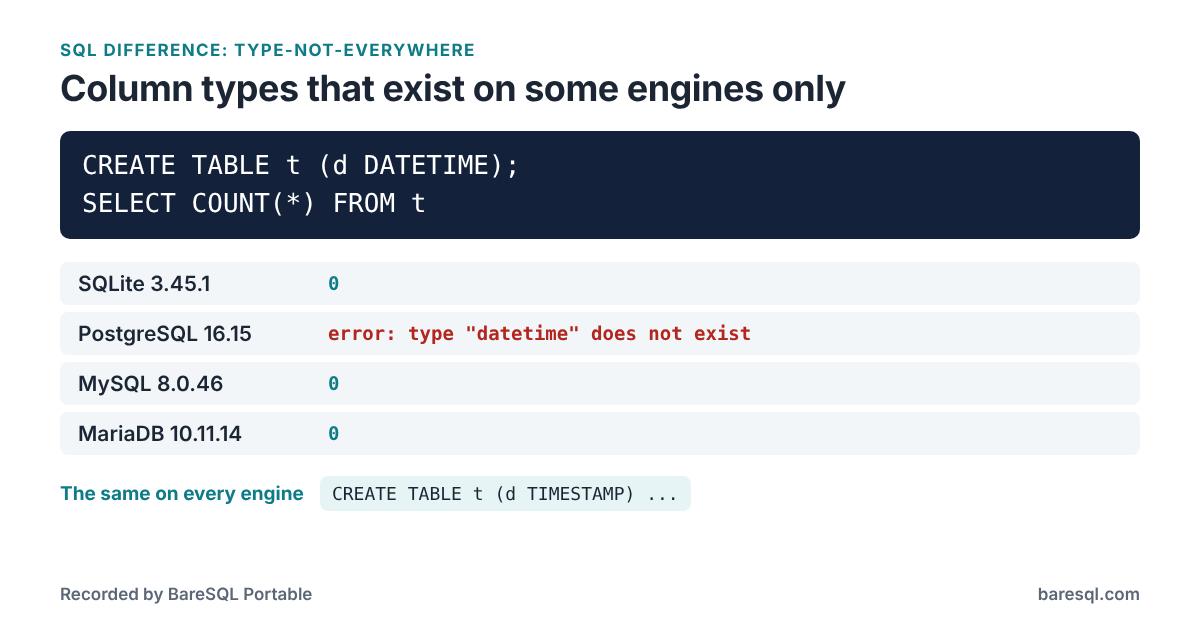
What Each Engine Answered
The example
CREATE TABLE t (d DATETIME);
SELECT COUNT(*) FROM t;
gave these answers:
| Engine | Answer |
|---|---|
| SQLite 3.45.1 | 0 |
| PostgreSQL 16.15 | error: type "datetime" does not exist |
| MySQL 8.0.46 | 0 |
| MariaDB 10.11.14 | 0 |
Every Form BareSQL Checks
BareSQL Portable checks 27 forms of this, and each was run on all four engines. yes means the engine ran it and the engines that ran it agreed, no means the engine refused it, and a value is what the engine answered where they disagreed.
| Form | SQLite | PostgreSQL | MySQL | MariaDB | What to write instead |
|---|---|---|---|---|---|
DATETIME |
yes | no | yes | yes | Use TIMESTAMP. |
TINYINT |
yes | no | yes | yes | Use SMALLINT. |
MEDIUMINT |
yes | no | yes | yes | Use INTEGER. |
DOUBLE |
yes | no | yes | yes | Use DOUBLE PRECISION. |
UNSIGNED |
yes | no | yes | yes | Use INTEGER, or BIGINT for large values, with CHECK (x >= 0). |
TINYTEXT |
yes | no | yes | yes | Use VARCHAR(255). |
MEDIUMTEXT |
yes | no | yes | yes | Use TEXT. On MySQL and MariaDB TEXT holds up to 64 KB. |
LONGTEXT |
yes | no | yes | yes | Use TEXT. On MySQL and MariaDB TEXT holds up to 64 KB. |
BLOB |
yes | no | yes | yes | No binary type works on all four: BYTEA on PostgreSQL. |
LONGBLOB |
yes | no | yes | yes | No binary type works on all four: BYTEA on PostgreSQL, BLOB on SQLite. |
ENUM |
no | no | yes | yes | Use VARCHAR(n) with CHECK (x IN ('a', 'b')). |
SET |
no | no | yes | yes | Use a separate table with one row per value. |
YEAR |
yes | no | yes | yes | Use SMALLINT. |
BYTEA |
yes | yes | no | no | No binary type works on all four: BLOB on SQLite, MySQL and MariaDB. |
TIMESTAMPTZ |
yes | yes | no | no | Use TIMESTAMP and keep times in UTC. |
TIMESTAMP WITH TIME ZONE |
yes | yes | no | no | Use TIMESTAMP and keep times in UTC. |
JSONB |
yes | yes | no | no | Use JSON on PostgreSQL, MySQL and MariaDB, and TEXT on SQLite. |
UUID |
yes | yes | no | yes | Use CHAR(36) or VARCHAR(36). |
INET |
yes | yes | no | no | Use VARCHAR(45). |
MONEY |
yes | yes | no | no | Use DECIMAL(19, 4). |
INTERVAL |
yes | yes | no | no | Store the length as a number of seconds or days. |
ARRAY |
yes | yes | no | no | Use a separate table with one row per element. |
NUMBER |
yes | no | no | no | Use DECIMAL(p, s) or INTEGER. |
VARCHAR2 |
yes | no | no | no | Use VARCHAR(n). |
NVARCHAR |
yes | no | yes | yes | Use VARCHAR(n); all four store Unicode in VARCHAR. |
CLOB |
yes | no | no | no | Use TEXT. |
DATETIME2 |
yes | no | no | no | Use TIMESTAMP. |
What to Write Instead
This form answers the same on every engine:
CREATE TABLE t (d TIMESTAMP);
SELECT COUNT(*) FROM t;
| Engine | Answer |
|---|---|
| SQLite 3.45.1 | 0 |
| PostgreSQL 16.15 | 0 |
| MySQL 8.0.46 | 0 |
| MariaDB 10.11.14 | 0 |
Use types that all four accept: INTEGER, BIGINT, SMALLINT, DECIMAL(p, s), DOUBLE PRECISION, VARCHAR(n), TEXT, DATE, TIME, TIMESTAMP and BOOLEAN. There is no binary type they share: BLOB on SQLite, MySQL and MariaDB, BYTEA on PostgreSQL.
What BareSQL Portable Reports
Saved as example.sql, the example gets this from baresql lint --all:
$ baresql lint --all example.sql
example.sql:1:19: error: DATETIME works on SQLite, MySQL and MariaDB; PostgreSQL refuses it. [type-not-everywhere]
    DATETIME
    Use TIMESTAMP.

1 problem: 1 error.
baresql rules type-not-everywhere prints the same answers in the terminal, and the BareSQL Portable page lists every difference BareSQL knows.