CHAR Columns Come Back Padded With Spaces on PostgreSQL
An order status kept in a CHAR(10) column compares as expected in SQL on every engine. In the application code, though, a check for paid orders fails on PostgreSQL alone.
A CHAR(5) column holding 'a' returns 'a ' on PostgreSQL. Comparisons there ignore the padding, so WHERE c = 'a' still matches, but the spaces reach the application and CONCAT. MySQL and MariaDB strip trailing spaces when they read CHAR values, and SQLite does not apply the length at all.
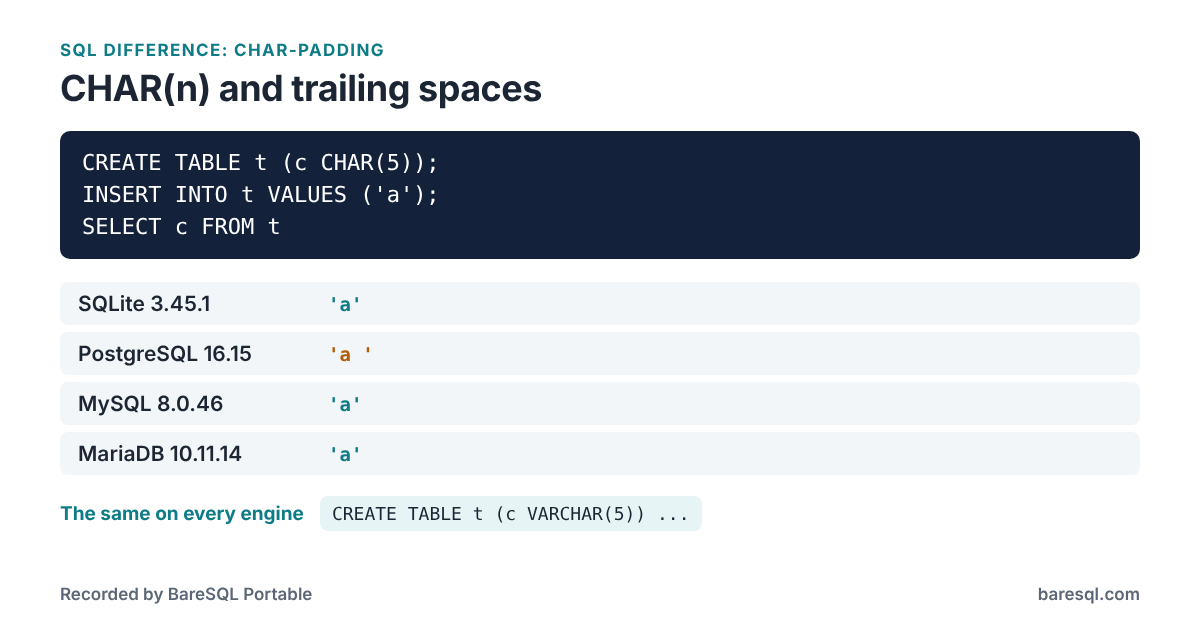
What Each Engine Answered
The example
CREATE TABLE t (c CHAR(5));
INSERT INTO t VALUES ('a');
SELECT c FROM t;
gave these answers:
| Engine | Answer |
|---|---|
| SQLite 3.45.1 | 'a' |
| PostgreSQL 16.15 | 'a ' |
| MySQL 8.0.46 | 'a' |
| MariaDB 10.11.14 | 'a' |
What to Write Instead
This form answers the same on every engine:
CREATE TABLE t (c VARCHAR(5));
INSERT INTO t VALUES ('a');
SELECT c FROM t;
| Engine | Answer |
|---|---|
| SQLite 3.45.1 | 'a' |
| PostgreSQL 16.15 | 'a' |
| MySQL 8.0.46 | 'a' |
| MariaDB 10.11.14 | 'a' |
Use VARCHAR(n) unless every value has exactly n characters.
What BareSQL Portable Reports
Saved as example.sql, the example gets this from baresql lint --all:
$ baresql lint --all example.sql
example.sql:1:19: info: PostgreSQL pads CHAR(n) values with spaces up to n characters; SQLite, MySQL and MariaDB give them back as stored. [char-padding]
    CHAR(5)
    Use VARCHAR(n) unless every value has exactly n characters.

1 problem: 1 note.
baresql rules char-padding prints the same answers in the terminal, and the BareSQL Portable page lists every difference BareSQL knows.